Martina Prša
1. Congratulations on winning in the New York Photography Awards! Can you share a little about yourself, what inspired you to pursue photography, and how has your journey evolved since your first shot?
Thank you. I’m a fine art photographer from Slovenia, focused on capturing emotion, atmosphere, and the subtle details that often go unnoticed.
I first picked up a camera to photograph handmade beaded jewelry I was creating, but it quickly became something much bigger. I became fascinated with how light, composition, and perspective could transform even the simplest subject into something visually compelling.
Since then, my journey has evolved from simple documentation into a more intentional and artistic approach. Today, I focus on creating images that carry both visual impact and emotional depth — whether through minimalistic fine art compositions or expressive subjects like horses, which are also a personal passion of mine.
2. Can you share the story or inspiration behind your award-winning piece? How does winning this award make you feel about your journey in photography?
Both award-winning pieces come from a strong connection to emotion and presence, expressed in different ways.
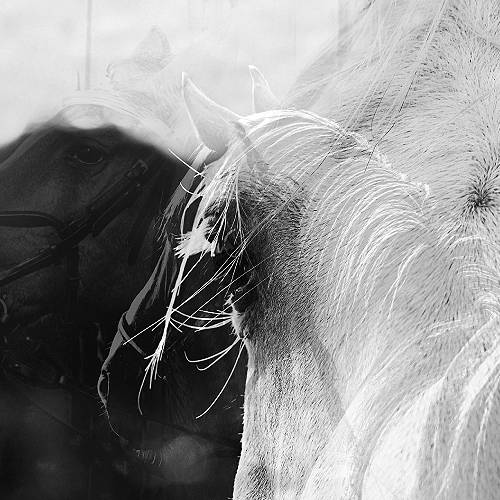
“Whispers of Grace” focuses on softness, elegance, and a quiet, almost intimate moment. I was drawn to the subtle interaction between the subject and the atmosphere, creating a sense of calm and sensitivity.
“In the Eye of a Horse” is more about detail and intensity. It explores focus, awareness, and the depth you can find in a single moment when you truly observe your subject. My connection to horses plays an important role here, allowing me to capture something more authentic and personal.
Winning this award is both motivating and confirming. It shows me that I’m on the right path and encourages me to keep pushing my work further, both creatively and technically.
3. How do you decide which photo to submit for a competition?
I choose the image that has the strongest impact — both visually and emotionally.
Technical quality is important, but it’s never the main factor. I look for a photograph that immediately stands out, holds attention, and communicates something beyond what is visible at first glance.
I also consider whether the image represents my artistic direction and whether it can stand on its own without explanation. In the end, it comes down to instinct — I trust the images that stay with me and feel complete.
4. What first made you pick up a camera?
I first picked up a camera to photograph handmade beaded jewelry I was creating at the time.
What started as simple documentation quickly turned into something more. I became interested in how light, composition, and perspective could completely transform even the smallest subject.
That curiosity pulled me deeper into photography, and over time it evolved into a creative process where I’m not just capturing an image, but shaping it into something with mood, depth, and meaning.
5. What’s your favorite type of photography, and why do you love it?
I’m most drawn to fine art photography that focuses on light, detail, and atmosphere.
I’m particularly interested in minimalistic compositions, where even the smallest element can create a strong visual and emotional impact. I enjoy transforming simple scenes into something more refined and intentional.
At the same time, photographing horses is a key part of my work. It’s something I’m personally connected to, as I also ride. That connection allows me to capture not just the subject, but its presence, movement, and character in a more authentic way.
What I value most is the ability to move between these two approaches — from subtle, quiet imagery to more powerful, living subjects — while maintaining a consistent artistic vision.
6. What’s your go-to camera setup, and why does it work best for your projects? What’s your favorite feature?
My go-to setup is a Canon EOS 90D, combined with a 50mm prime lens, a macro lens, or a telephoto zoom, depending on the subject.
What makes it work best for me is the flexibility and control it gives me across very different types of work — from fine art detail to more dynamic subjects like horses.
I always shoot in manual mode. It allows me to fully control light, depth, and atmosphere, which is essential for achieving a consistent visual style.
My favorite feature is that control itself — the ability to consciously shape every element of the image and not rely on automatic decisions. It keeps the process intentional and closely connected to my vision.
7. If someone looked at your work, what’s the one thing you’d want them to feel?
I’d want them to lose themselves in the image, even if just for a moment.
To step away from reality, find something personal in it, and create their own story. For me, the goal is not to tell the viewer what to see, but to give them space to feel and interpret it in their own way.
8. What was the most challenging part of capturing your winning shot?
The challenge wasn’t in the moment of capturing the image, but in recognizing its full potential.
A big part of my process happens afterward, when I review the images and decide how to develop them further. That’s where I shape the final impact — refining the mood, the contrast, and the overall presence of the image.
For me, it’s less about overcoming a single obstacle and more about making the right creative decisions that turn a strong capture into a complete piece.
9. Is there a specific place or subject that inspires you the most?
I’m inspired by whatever captures my attention in the moment — it can be light, a detail, or a certain atmosphere.
That said, horses are a constant source of inspiration for me. I have a personal connection to them, as I also ride, and that allows me to approach them with a deeper understanding of their movement, sensitivity, and presence.
They offer both strength and subtlety, which aligns closely with the way I see and create images.
10. Who or what has been your biggest influence in photography?
I don’t have one specific person I would call my biggest influence.
My focus has always been on developing my own perspective and improving with every image I create. I’m more driven by the process itself — observing, experimenting, and refining my work over time.
For me, the strongest influence comes from within — from the need to evolve and to express my vision more clearly with each photograph.
11. What message would you share to inspire photographers to participate in photography awards, and what advice would you give to help them excel in the competition?
Photography awards are a strong source of motivation and a way to confirm that you’re moving in the right direction.
They push you to look at your work more critically, to select your strongest images, and to present your vision with intention.
My advice would be to stay true to your own style and not try to chase trends. The images that stand out are the ones that feel authentic and confident. Trust your instinct, choose your strongest work, and don’t hesitate to put it out there.
12. What’s one piece of advice for someone just starting in photography?
Don’t be afraid to make mistakes — they’re an essential part of the process.
The most important thing is to keep shooting, keep experimenting, and not overthink the outcome. Every image you create helps you improve and brings you closer to finding your own style.
13. What role do editing and post-processing play in your creative workflow?
Editing and post-processing are a key part of my creative workflow.
As an artist, I see the original image as a starting point, not the final result. Through editing, I refine the mood, enhance the visual impact, and shape the image into something more intentional.
It’s the stage where a simple capture becomes a complete piece — where I transform an ordinary image into something with depth, atmosphere, and a clear artistic direction.
14. How do you see technology, like AI, influencing the future of photography and your own approach?
I see technology, including AI, as a tool that can support and expand the creative process.
It offers new possibilities and can make certain parts of the workflow more efficient, but I don’t see it as a replacement for the artist. The core of photography will always come from human vision, feeling, and intention.
In my own work, I see it as an addition — something that can assist, but not define the final result. The direction and meaning of the image will always come from me.
15. If you could photograph anything or anyone in the world, what would it be?
I don’t focus on a specific person or place. For me, it’s about the moment when something truly resonates. When I find the right subject, I’ll know — it’s always a matter of connection and instinct.